
Conservation & Human Rights
Upcoming: a decolonized alternative to the World Conservation Congress
This September, as world leaders and conservation NGOs gather for the World Conservation Congress, Indigenous Peoples on the frontlines of deforestation will again be kept out of the decision-making process as these leaders push for more protected areas and “nature-based solutions” – both of which are at high risk for creating human rights violations and … Read more

Statement: Protected areas in the Democratic Republic of Congo – a broken system
Statement: Protected areas in the Democratic Republic of Congo – a broken system 25th January 2021 Peoples and ecosystems in the Democratic Republic of Congo are being failed by the way conservation is practised. Indigenous Peoples and local communities face frequent threats of intimidation, torture, beatings, sexual violence and death at the hands of ecoguards … Read more
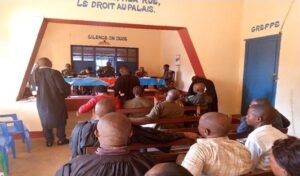
Huge leap in fight against impunity for conservation-related abuses in DRC as park rangers are sentenced for rape and torture
On 28 December 2020, five park rangers accused of raping and torturing four women in DRC’s Salonga National Park were convicted by the Military Court in Mbandaka, following a long battle for justice supported by the Rainforest Foundation UK (RFUK) and its local partner Actions pour la Promotion et Protection des Peuples et Espèces Menacés … Read more

300 MILLION AT RISK FROM CBD DRIVE
The ‘Post-2020 Global Biodiversity Framework’ – How the CBD drive to protect 30 percent of the planet could dispossess millions.
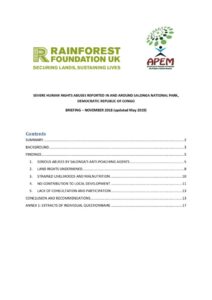
Severe Human Rights Abuses Reported in and around Salonga National Park
An investigation by the Rainforest Foundation UK (RFUK) and Congolese NGO Actions pour la Promotion et la Protection des Peuples et Espèces Menacés (APEM), uncovered a worrying number of human rights abuses allegedly carried out by Salonga National Park’s anti-poaching agents, who receive support and funding from a range of international donors. Allegations include cases … Read more

Protected Areas and Community Rights: Using Local Maps to Support Sustainable Conservation in the Congo Basin
The best conservation projects start with people. Yet protected areas in the Congo Basin continue to be established and managed with poor consideration for local communities’ land and resource rights, fostering conflicts and human rights abuses. A lot of these toxic situations could be avoided if thorough participatory community mapping data, such as collected through MappingForRights, … Read more

The Human Cost of Conservation in Republic of Congo
This report is based on investigations in Republic of Congo by our local civil society partners, mainly within six forest communities living in or on the periphery of Conkouati-Douli National Park (CDNP) and Nouabalé-Ndoki National Park (NNNP). The aim of our investigations was to understand the impact of the protected areas on those communities and … Read more
Aid-funded conservation guards accused of extrajudicial killing
The Rainforest Foundation UK (RFUK) and three leading Congolese human rights organisations have today written to international conservation organisations and government aid agencies calling for an investigation into a new case of extrajudicial killing of a man by ‘eco-guards’ in Republic of Congo. The 32-year old man, called Freddy Ndadé, was arrested near the border … Read more

Protected Areas in the Congo Basin: Failing Both People and Biodiversity?
Protected areas in Africa’s great equatorial rainforests are falling well below expectations both in terms of conserving wildlife and respecting local peoples’ rights. Watch this short film about forest communities affected by the Tumba Lediima Reserve in the Democratic Republic of Congo (DRC).

Protected Areas in the Congo Basin: Failing Both People and Biodiversity?
Based on a sample of 34 protected areas across Cameroon, the Central African Republic, the Democratic Republic of Congo, Gabon and the Republic of Congo, including four detailed case studies, this study reveals that biodiversity in the region continues to decline, that there is little evidence that the ‘guns and guards’ approach to protected areas … Read more